Staff Augmentation vs. Dedicated Development Team: Which Model Is Right?

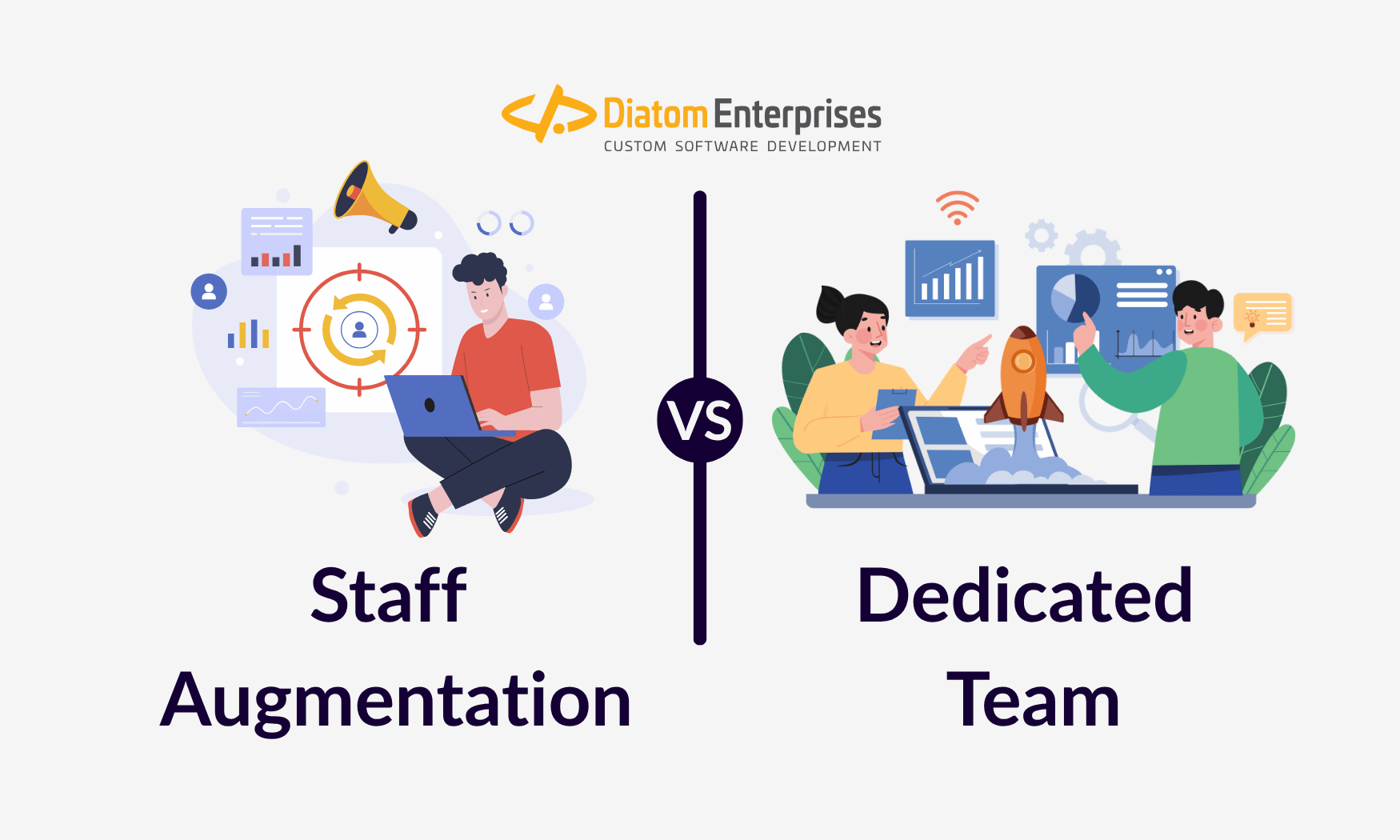
Table of content
What's the Difference Between Staff Augmentation and a Dedicated Team?
Both models bring in external engineers; the difference is who runs the work. With staff augmentation, a vendor supplies individual engineers who work under your managers, inside your process. With a dedicated development team, the vendor supplies a complete unit with its own lead and QA, which owns delivery of a product or workstream while you set the priorities. A quick test: if you have a tech lead with time to assign and review work, augmentation fits. If nobody on your side can run a team, look at a dedicated one.
Understanding Staff Augmentation
Staff augmentation works like a contract hire arranged through a vendor. You name a specific need, for example a React developer for a three-month feature push, and the vendor provides a qualified engineer who works under your direct management. The engineer joins your standups, commits to your repositories and reports to your engineering manager. Depending on the role, development staff augmentation can bring in mid-level engineers for well-scoped work or senior specialists for harder problems.
The model fits short-term gaps. You add or release people month to month without running a hiring process. Speed has a limit, though: Fred Brooks observed in The Mythical Man-Month (1975) that adding people to a late software project makes it later, because newcomers need time to learn the codebase and every extra person adds communication. Plan an onboarding period and name a contact person on your side.
The main benefit is control. You assign the tasks and review the code, so augmented engineers follow your workflow exactly. That is also the main cost. Onboarding and responsibility for the result stay with you, and someone on your side writes tickets and reviews pull requests every day. That time never appears on the vendor’s invoice.
Larger, long-term initiatives usually need a cohesive unit that can run on its own, so many companies build a dedicated development team that takes ownership of a product or a workstream. Our guide to what staff augmentation is covers the first model in more detail.
The Dedicated Development Team Model Explained
When you hire dedicated developers as a team, you engage a complete external unit that works as a remote extension of your company. Besides developers, it usually includes a project manager or team lead, QA engineers and, when the product needs one, a UI/UX designer. The same people stay on your product month after month, so knowledge builds up inside the team.
The model rests on shared responsibility. The vendor manages the people, the delivery process and the quality of the output; you own the product direction and accept each release. Keep a product owner on your side, though. A dedicated team without someone who can answer business questions within a day either slows down or builds the wrong thing.
A dedicated team fits large, long-term projects whose requirements change as you learn, such as building a new SaaS product from scratch or a multi-year modernization of a legacy platform. Over time the team learns your codebase and your users, and starts proposing changes instead of waiting for tickets. Keep each team small: the Scrum Guide describes a Scrum Team as typically 10 or fewer people, so a larger effort works better as two teams on one product.
The monthly cost is usually higher than one or two augmented engineers, because you pay for a whole team and its management. What you buy is ownership of delivery. Before you hire dedicated software development team members from a vendor, ask who leads the team, how much of it is senior, how a departing engineer is replaced, and how many working hours overlap with yours.
Key Factors for Your Decision
Project Scope and Duration
- Staff Augmentation: Best for work of a few months (for example 3 to 6) with a clear scope, such as new features in an existing product whose architecture and processes are already set.
- Dedicated Team: Fits long, complex projects (a year or more) whose requirements will change. Building a product from the ground up, followed by continuous development and maintenance, is the typical case.
Management and Control
- Staff Augmentation: You keep full control and management responsibility. Your tech leads assign tasks, review code and manage the augmented developers directly. If code reviews already queue up, more engineers will make the queue longer.
- Dedicated Team: Management is shared. The vendor’s project manager or team lead runs daily operations, and you set the direction and priorities. Choose this model when you want to hand off the work of running a development process.
Cost and Budgeting
- Staff Augmentation: Usually billed as time and materials, an hourly or monthly rate per engineer. It is a flexible operating expense (OpEx), predictable for short needs, but it adds up over long periods once you count your own management time. For example, two engineers at an assumed $50 per hour (an assumption for illustration, not a quote) for 160 hours a month cost $16,000 a month, plus your tech lead’s time.
- Dedicated Team: Usually a fixed monthly fee that covers the team’s salaries, the vendor’s overhead and team management. The commitment is larger, but on long projects it often gives better value and a steadier budget. Ask how the fee changes when you add or remove a role.
Integration and Team Culture
- Staff Augmentation: Integration is mostly about skills. The engineer has to pick up your tools and processes quickly. For a short engagement, technical ability counts for more than cultural fit.
- Dedicated Team: Cultural alignment decides how well the model works. The team becomes part of your company and has to understand your users and how you make decisions. Agree early on shared tools (issue tracker, repositories, chat and CI) and one definition of done.
Finding the Right Fit for Your Business
Match the engagement model to the shape of the project. A mismatch shows up quickly: augmented engineers left without direction, or a dedicated team waiting on decisions nobody on your side has time to make. Ask two questions: does someone on your team have the hours to manage more engineers every day, and is this a short push or a product you will develop for years? The answers point to individual specialists, a hybrid, or a self-managed dedicated software team.
At Diatom Enterprises, staff augmentation can include mid-level engineers when the role allows it, while dedicated teams are built from our 80+ senior engineers. We have worked with clients, mainly in North America and Western Europe, since 2004.
Freelance platforms and LinkedIn work for finding a single freelance developer for hire. When you hire dedicated web developers or other specialists through a vendor, you also get vetting, a replacement if someone leaves, and a contract that makes the vendor accountable. For a fully outsourced model, see our comparison of staff augmentation vs managed services.
The Final Verdict
The choice between staff augmentation and a dedicated team is about fit, not about which model is better. Staff augmentation adds skills to your team quickly, under your own management. A dedicated development team is a long-term investment in a self-sufficient team that owns your product’s development lifecycle. Review the scope and your management capacity first; the budget usually follows from those two.
Frequently Asked Questions
- Dedicated team vs staff augmentation: which fits a long-term product build? Usually a dedicated team, because a stable team keeps its knowledge. Augmentation still works for a long build if you have a strong in-house tech lead and need extra people in specific roles.
- Should I hire dedicated developers or augment my team? Augment your team if you have management capacity and a clear task list. Bring in a dedicated team if you need someone to own delivery end to end.
- Which model suits an enterprise modernization project with fluctuating workloads? Often a hybrid: a small dedicated core team keeps the architecture consistent, and augmented engineers join for peaks such as data migration, then leave.
- How do we move from staff augmentation to a dedicated development team? In stages. Ask vendors about engineer retention, career development and how a departing engineer hands over knowledge. Move one workstream first, run both setups side by side for a sprint or two, then transfer the rest.
Ready to find the right development model for your project?
Contact us for a free consultation, and let’s discuss how we can help you build the right team for your goals.