
MCP vs API: Designing Scalable Integration Architectures for AI Agents

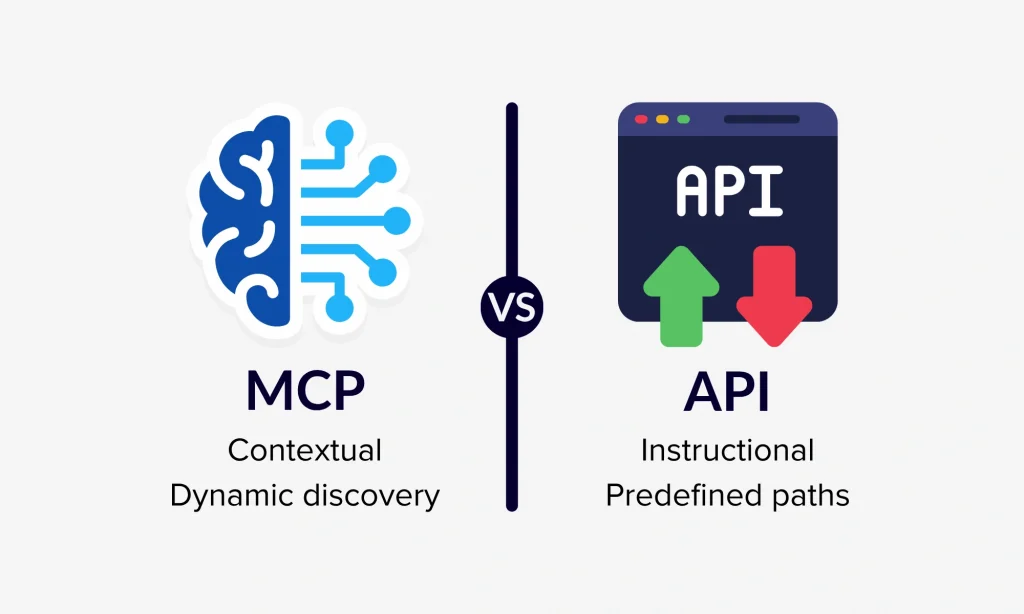
As businesses transition from simple chatbots to autonomous agentic systems, standard integration practices are breaking under the weight of LLM orchestration. This guide analyzes the architectural shift from traditional API endpoints to the Model Context Protocol (MCP). We examine how MCP differs from native tool calling, where traditional APIs remain indispensable, and how to structure a modern, model-agnostic intelligence layer.
The Integration Bottleneck in the Agentic Era
Traditional software engineering is built on the concept of predictable, rigid contracts. Application Programming Interfaces (APIs) act as these contracts, defining exactly what data must be sent and what will be returned. This paradigm works flawlessly when human developers write the code that connects two deterministic services.
However, when large language models (LLMs) enter the loop as autonomous actors, this static contract structure becomes a massive integration bottleneck. LLMs do not inherently understand proprietary API documentation, nor can they dynamically adapt to changes in a REST endpoint’s query parameters without code changes. To bridge this gap, engineers have historically built heavy, bespoke middleware layers. This middleware takes the unstructured intent of the LLM, parses it, maps it to specific API endpoints, handles authentication, executes the call, and translates the raw JSON payload back into a format the model can consume.
This approach scales poorly. For every new data source, internal tool, or external service an agent needs to access, developers must write, test, and maintain a unique integration loop. If you decide to switch your underlying LLM provider, you often have to rebuild or heavily refactor these integration wrappers due to differences in how various models expect to receive tool schemas and return tool execution requests. This fragmentation is driving the industry toward standardized integration layers that treat LLMs not as simple API consumers, but as runtime environments that negotiate capabilities dynamically.
Decoupling the Stack: MCP vs Tool Calling
To build a maintainable AI infrastructure, developers must understand the technical distinction between native tool calling and the Model Context Protocol.
Native tool calling (frequently referred to as function calling) is an execution primitive built directly into an LLM provider’s API. Under this model, the developer defines a set of tools using JSON schemas and passes these schemas inline inside the system prompt or API payload to the LLM. When the model processes a prompt and determines it needs external data, it pauses generation and outputs a structured JSON object containing the name of the function it wants to run and the arguments it has generated. The client application must intercept this output, execute the actual code or database query locally, and send the result back to the LLM in a subsequent turn.
While highly effective for simple, closed loops, native tool calling is tightly coupled to the specific model’s API format. A schema written for OpenAI’s function calling does not port cleanly to Anthropic’s tool use or Google’s Gemini tool definitions without translation middleware.
The Model Context Protocol (MCP) is an open-standard, client-server protocol that abstracts this process entirely. Instead of passing tool definitions inline within every single LLM prompt payload, MCP introduces a decoupled architecture split into clients and servers. The MCP client (an IDE, a browser, or a custom agent framework) hosts the LLM and orchestrates the user experience, while the MCP server acts as a lightweight, independent service that exposes specific databases, legacy applications, or prompt templates. Communicating over JSON-RPC 2.0 via standard transports like stdio or Server-Sent Events (SSE), the client and server perform a handshake upon initialization.
The server dynamically advertises its available resources and tools, allowing the client to translate these capabilities dynamically into whatever format the host LLM requires, keeping sensitive database credentials and custom execution environments safely isolated from the client application.
Comparison Matrix: API vs. Tool Calling vs. MCP
The table below breaks down the structural differences across traditional integration, model-specific execution, and protocol-based orchestration:
| Architectural Dimension | Traditional API | Native Tool Calling | Model Context Protocol (MCP) |
|---|---|---|---|
| Communication Protocol | HTTP (REST), gRPC, GraphQL | Model-specific HTTP JSON payloads | JSON-RPC 2.0 over stdio or SSE |
| Discovery Mechanism | Static documentation (OpenAPI/Swagger) | Injected manually in LLM system prompts | Dynamic runtime negotiation during client-server handshake |
| Execution Location | Remote host server | Local orchestrator application hosting the LLM | Dedicated MCP Server (local or remote) |
| Security Boundary | Managed via API gateways, OAuth, and API keys | Credentials must live inside the orchestrator application | Credentials remain encapsulated within the isolated MCP server |
| Model Portability | N/A (Consumable by any software) | Low (Bespoke schemas required for each LLM provider) | High (Client abstracts model differences; server is completely model-agnostic) |
| Payload Overhead | Low (Structured data transfer) | High (Requires sending tool schemas in prompt context every turn) | Optimized (Schemas are queried once at session initialization) |
Architectural Trade-Offs: Benefits and Limitations of Both Worlds
No single architectural pattern is a silver bullet. Deciding between a standard web API, direct tool calling, and MCP requires weighing execution speeds against organizational flexibility.
Traditional APIs combined with native tool calling provide unmatched performance and precision. By bypassing translation layers, direct calls to REST or gRPC endpoints eliminate serialization latency, which is essential for real-time systems. Developers also maintain complete control over the context window, dynamically pruning tool definitions based on the user’s immediate state to save tokens. Additionally, this approach integrates seamlessly with decades of established testing, logging, and deployment pipelines.
However, this model introduces a heavy integration tax. A firm maintaining multiple internal databases across various agentic software projects must build and maintain bespoke wrappers for every combination, creating a fragile network of dependencies that can fail whenever a database schema or LLM endpoint changes.
The Model Context Protocol addresses these scaling bottlenecks through standardization and decoupling. By writing an MCP server once, developers expose databases, vector search indices, or local filesystems to any compatible client-be it an IDE like Cursor, a desktop terminal, or an enterprise agent – without rewriting any glue code. It also separates organizational concerns: platform teams can manage, update, and secure the data-facing MCP servers independently of the application teams building the front-end user experiences. When a database changes, the server’s updated capabilities are instantly discovered by clients during the next handshake.
Despite these benefits, MCP is a younger standard with evolving security, authorization, and telemetry frameworks, and remote setups running over Server-Sent Events can introduce network overhead compared to highly optimized direct API routes.
Strategic Implementation: When to Build Custom APIs vs. MCP Servers
Software architects must draw clear boundaries between where custom API work is required and where the open-standard MCP layer should be implemented.
A custom API and native tool-calling approach is highly recommended when engineering commercial, public-facing software-as-a-service (SaaS) products. When external customers are connecting sensitive accounts like Salesforce or HubSpot, managing user authentications, OAuth tokens, and concurrency is best handled via a centralized orchestrator.
This method is also preferred in environments with ultra-low latency requirements, where every millisecond counts, or when available tools must change continuously and dynamically on a turn-by-turn basis depending on the immediate context of a conversation.
Conversely, wrapping infrastructure inside MCP servers is the optimal route for internal developer utilities, multi-agent frameworks, and model-agnostic platforms. When internal engineering, sales, or support teams need to safely interact with core data lakes or trigger backend jobs through multiple front-ends like Slack, web consoles, or development environments, MCP centralizes authentication and schema discovery into a single service.
This structure future-proofs the enterprise stack, ensuring that when the time comes to swap, upgrade, or benchmark alternative LLM models, the underlying system integrations remain entirely untouched.
If you’re weighing custom API work against an MCP-based architecture for your own agentic systems, reach out to Diatom Enterprises through our signup form and we’ll help you map out the right approach.