


Peculiarities And Definitions Of Manual And Automation QA Testing Services
Numerous young, tech-curious workers, as well as seasoned experts who have made a career transition, are drawn to software testing. So are the company founders and project owners. The choice between manual and automation testing services will be an important one for them to make. What are the advantages and disadvantages of these two approaches from a professional standpoint?
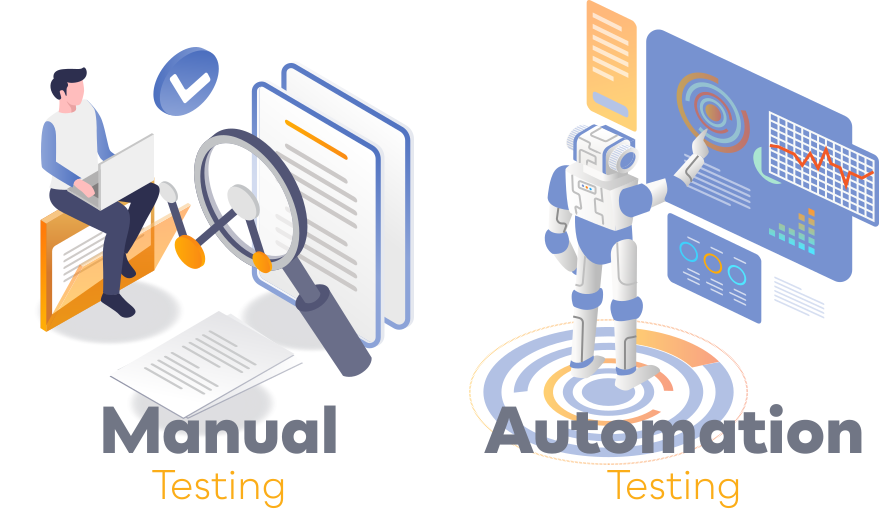
Firstly, let’s define the meaning and aim of manual and automated QA testing. The tests in manual testing are, as the name implies, performed manually, i.e., by humans. They don’t rely on any external programs or scripts in any way. That’s why you won’t need any scripting experience but be prepared for a lengthy process.
Contrarily, test cases are carried out with the use of software and scripts in automated testing. The objective here is to speed up test execution by the elimination of human interaction in repetitive tasks and regression tests. However, even in this scenario, testing scripts still need to be built, and this takes time and effort.
There is no single, definitively superior option. Manual and automated testing can both be useful, but when to use both depends on a number of factors. Let’s carefully review each of them.
In both methods – automation and manual, specific testing types are covered such as integration testing, system testing, performance testing, and load testing. However, some of those testing types are better executed in a manual approach and some – by automation. Keep reading to learn more about the benefits and disadvantages of both testing approaches.
Obviously, there are benefits and drawbacks to both manual and automated testing. The results of manual testing, for instance, can be more reliable because they’re based on the actual human experience. It also doesn’t call for any familiarity with coding. Conversely, automated testing aids bug discovery by means of a quick and effective procedure that may be documented.
Are you willing to choose the most efficient solution for your project? Don’t hesitate to rely on our trustworthy review to make your own decision. Diatom Software Testing team will be your reliable partner when it comes to choosing the most efficient software testing solution. Just entrust your choice to dedicated manual and automated software testing professionals and let them do the rest.
- Enjoy prompt and reliable visual feedback.
- Cost-Efficiency. As you won’t need to invest in costly automation software and procedures, you’ll save money.
- You can always count on human assessment and intuition to improve the manual component.
- For even a little testing update, the time investment in creating an automation test could be excessive. While manual testing in a blink of an eye is a beneficial option.
- The human factor makes this testing procedure less reliable. Since this is the case, it will always have some flaws and shortcomings.
- Since manual testing cannot be recorded, it cannot be used again.
- Several tasks are challenging to accomplish manually in this testing approach, which may extend the software testing phase.
- You can identify more errors with automated testing than with a human tester.
- The majority of the testing procedure can be automated, allowing for a quick and effective solution.
- Monitoring of the automation procedure is possible. Therefore, you can utilize the same testing procedures over and over again.
- In contrast to manual testing, which relies on human factors like memorizing and tiredness, automated testing is carried out with the aid of computer programs.
- Automation testing requires specialized technologies that might add significantly to a project’s budget.
- Currently, there is no automated testing instrument that can guarantee 100% accuracy. All automation tools are bound by certain constraints that limit their usefulness.
- There is also the significant challenge of debugging the test script in automated testing. Upkeep of tests might be somewhat pricey.
The importance of having manual or automation QA engineers within your project can’t be underestimated. The reason why is that Software Testing and QA Services are irreplaceable and crucial parts of the software development process.
The job of a quality assurance engineer is to aid in the production of high-quality products. It’s not only about checking for flaws or doing basic testing. A quality assurance engineer’s primary responsibility is defect prevention, which in turn protects the integrity of the development cycle and its output. So what’s the main mission of the QA testing services professionals?
- Detect flaws and irregularities in the product at any time during the project.
- Aid in outlining the project’s needs.
- Supply in-depth data on the product’s quality.
- Put the product through its paces at each stage of the software development lifecycle (SDLC) process.