


Introduction to .NET MAUI
.NET Multi-platform App UI (.NET MAUI) is Microsoft’s open-source framework for native Android, iOS, iPadOS, macOS and Windows apps from one C# and XAML codebase. This article covers .NET MAUI cross-platform app development and Xamarin migration; for a full overview, read What is .NET MAUI.
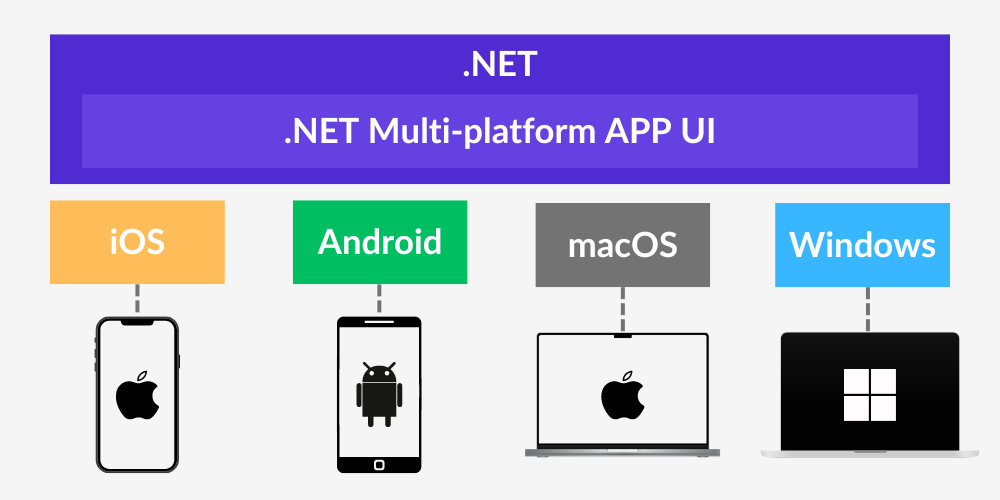
Aiming for Code Base Unification
App logic and UI layout live in one project that builds and debugs on all four supported platforms.
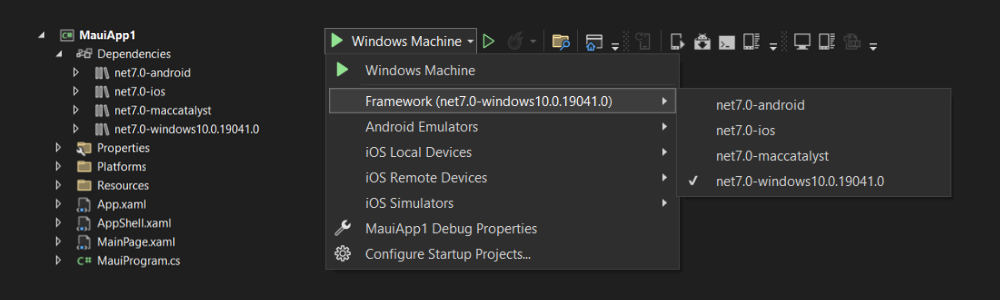
Like Xamarin, .NET MAUI produces native app packages:
- Android apps are compiled from C# into intermediate language, then just-in-time (JIT) compiled into a native assembly when the app launches.
- iOS apps are fully ahead-of-time (AOT) compiled into native ARM code.
- macOS apps run on Mac Catalyst, with AppKit APIs added where needed.
- Windows apps use the WinUI 3 library.
Extended Pattern Support and Library Integration
MVVM (model-view-viewmodel) is the main pattern, ReactiveUI (RxUI) works on top of it, and Blazor Hybrid reuses Razor components in a native app. The MVU (model-view-update) support expected in 2023 never shipped: Microsoft’s Comet is still experimental, so MVU means community libraries such as MauiReactor.
Syncfusion, Telerik and DevExpress sell .NET MAUI control suites; the open-source .NET MAUI Community Toolkit covers common controls.
Performance Comparison and Release Support
Jonathan Peppers’ 2022 article on the Microsoft blog measured about 493 labels per second for a .NET 7 MAUI app on a Pixel 5, against 327 on .NET 6.
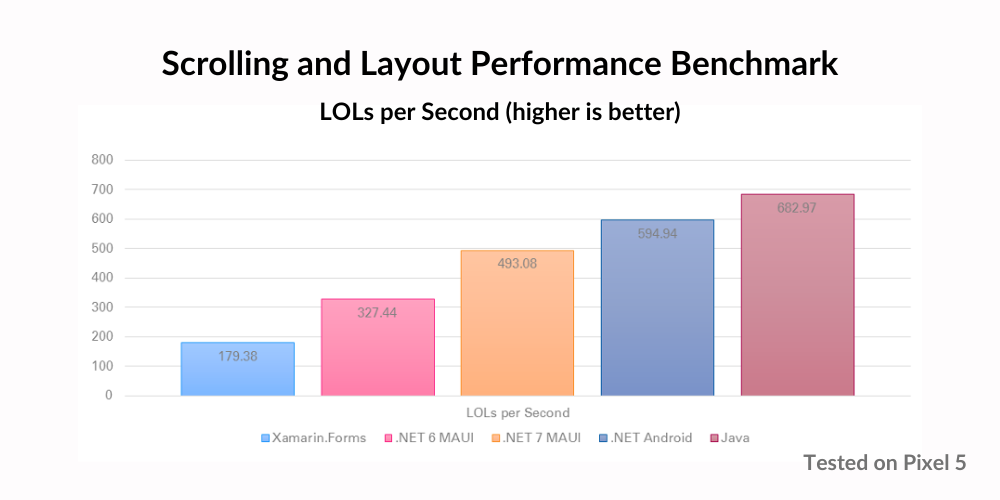
His benchmark repository lists about 179 for Xamarin.Forms 5, almost three times slower in one rendering test. A correction to the 2023 text: .NET MAUI has its own support policy, separate from .NET LTS. Each version is supported for six months after the next one ships, so .NET MAUI 6 support had already ended on 8 May 2023.
End of Xamarin Support and Migration to .NET MAUI
Xamarin support ended on 1 May 2024. The Xamarin support policy now names Android API 34 and Xcode 15 as its last SDKs, not the Android 13 and Xcode 14 announced in 2023. App Store uploads have required Xcode 26 since 28 April 2026, and Google Play updates must target API level 36 from 31 August 2026, so Xamarin apps can no longer ship store updates.
Custom renderers take the most migration work. Many still run as shimmed renderers; Microsoft recommends rewriting them as handlers (once called slim renderers). .NET MAUI 11 no longer ships the optional compatibility package, so code that depends on it must move first.
What Has Changed Since 2023
.NET MAUI 8, 9 and 10 shipped in November 2023, 2024 and 2025. MAUI 11 arrived with .NET 11 on 10 November 2026, made CoreCLR the default runtime and is supported until 9 May 2028; version 10 remains supported until 11 May 2027. Regulated industries should plan a yearly upgrade, not a three-year LTS horizon. Version 10 deprecated ListView and TableView in favour of CollectionView, made MessagingCenter internal and added an opt-in XAML source generator.
.NET MAUI Alternatives and Choosing a Partner
Alternatives include Flutter, React Native (governed since 24 February 2026 by the React Foundation under the Linux Foundation) and Kotlin Multiplatform. For .NET cross platform mobile development, Uno Platform and Avalonia also target Linux and the browser. .NET MAUI fits teams already on C# that need Windows as well as mobile. When comparing .NET MAUI development services, ask each .NET MAUI app development company for a Xamarin migration it has shipped and its upgrade plan.
Conclusion
.NET MAUI is Microsoft’s supported choice for new C# apps across mobile and Windows. For Xamarin apps, migration is overdue.
Considering migrating your existing projects to .NET MAUI? Or starting a new one? Diatom Enterprises has 80+ senior engineers and the cross-platform software development expertise to plan the move. Contact us.


