
RAG vs Fine-Tuning: A Guide to Choosing the Right AI Approach

Vlad Mart
- May 8, 2026
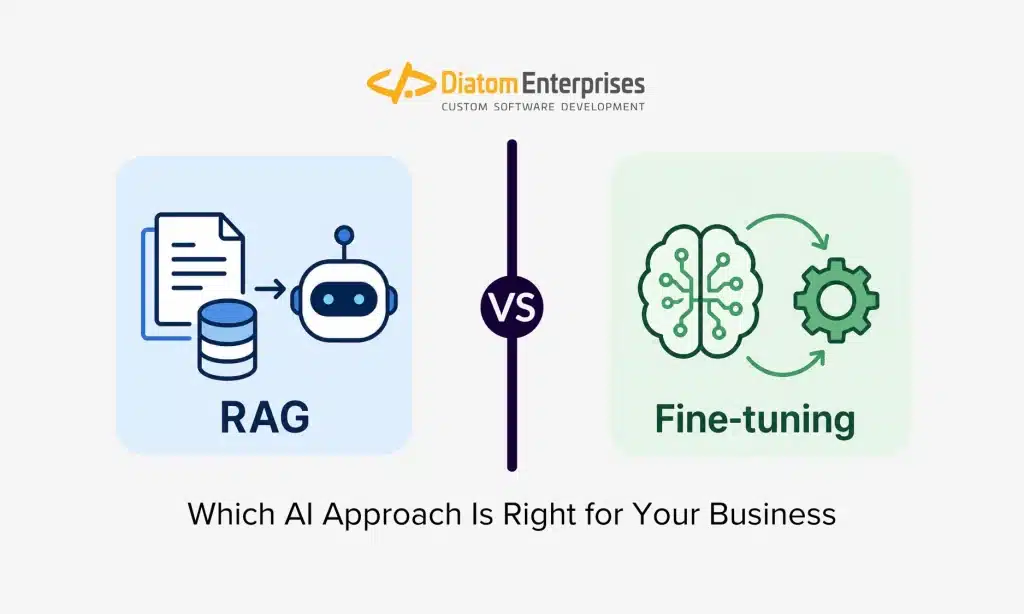
Deploying an AI model is only the beginning. The real strategic challenge – and the one that determines whether an AI investment delivers meaningful business value – is making that model useful in your specific context. A general-purpose large language model trained on broad internet data does not inherently know your products, your customers, your internal processes, or your industry’s specific terminology and requirements. Closing that gap is where two techniques have emerged as the leading approaches: retrieval-augmented generation, widely known as RAG, and fine-tuning. The debate around RAG vs fine-tuning is one of the most practically important conversations in enterprise AI today. This guide explains what each approach is, how they compare, and how business leaders can think clearly about which one – or which combination – is right for their specific needs.
Why Adapting AI Models to Your Business Context Matters
Out of the box, even the most capable large language models have significant limitations for business use. They do not know what happened in your organization last week. They do not have access to your product documentation, your customer history, or your internal knowledge base. They may use language that does not match your domain, make confident claims about topics where your business has specific requirements, or produce outputs that are accurate in general but wrong for your specific context.
Adapting AI models to close these gaps is not a nice-to-have for serious business deployment – it is a prerequisite for reliable, trustworthy, and genuinely useful AI capability. RAG and fine-tuning are the two principal mechanisms for achieving that adaptation, and understanding the difference between them is essential for any business leader making decisions about AI architecture and investment.
What Is RAG?
RAG – retrieval-augmented generation – is a technique that enhances an AI model’s responses by giving it access to an external knowledge base at the point of generating a response. Rather than relying solely on what the model learned during training, a RAG system retrieves relevant information from a defined set of documents, databases, or knowledge sources, and provides that information to the model as context when formulating its answer.
The process works in three stages. When a query arrives, a retrieval system searches the external knowledge base for the most relevant pieces of information. Those retrieved pieces are then passed to the language model alongside the original query. The model uses both the query and the retrieved context to generate a response that is grounded in your specific, current information rather than in its general training data alone.
What is RAG in practical terms for a business? Imagine a customer service AI that can accurately answer questions about your current product catalog, your specific return policy, and the details of a customer’s individual account – all drawn from live business data rather than static training. Or an internal knowledge assistant that can retrieve and synthesize information from your organization’s documentation, policies, and past project records in response to employee queries. These are RAG applications, and they represent one of the most immediately practical and widely deployed AI techniques in enterprise settings today.
The key characteristic of RAG is that the knowledge it draws on is external to the model and can be updated independently. When your product catalog changes, your RAG system reflects those changes without any modification to the underlying AI model. This makes RAG particularly well-suited to use cases where the information the AI needs to access is dynamic, frequently updated, or too voluminous to incorporate into model training.
What Is Fine-Tuning an LLM?
What is fine-tuning an LLM? Fine-tuning is the process of taking a pre-trained large language model and continuing its training on a curated dataset of examples specific to your domain, use case, or desired behavior. The result is a model whose weights – the internal parameters that determine how it processes and generates language – have been adjusted to reflect the patterns, terminology, style, and knowledge present in your fine-tuning data.
Where RAG gives a model access to external information at inference time, fine-tuning changes the model itself. A fine-tuned model has internalized the knowledge and behavioral patterns from its training data – it does not need to retrieve that information from an external source because it has, in a meaningful sense, learned it.
The practical implications of this distinction are significant. A model fine-tuned on your customer support transcripts will have absorbed the language patterns, common issues, resolution approaches, and tone of voice that characterize your support operation – not as retrieved context, but as internalized behavior. A model fine-tuned on legal documents from your specific jurisdiction will reason about legal questions in a way that reflects the specific conventions and requirements of that domain. A model fine-tuned on your brand’s content will write in your voice, use your terminology, and reflect your values – consistently, without requiring those preferences to be re-specified in every prompt.
Fine-tuning is a more substantial technical undertaking than RAG. It requires a well-curated training dataset, computational resources for the training process, expertise in model training and evaluation, and ongoing investment in maintaining and updating the fine-tuned model as requirements evolve. But for use cases where the depth of domain adaptation it enables is what the application requires, it is the technique that makes it possible.
RAG vs Fine-Tuning: A Direct Comparison
With both techniques understood, the RAG vs fine-tuning comparison comes into focus across several dimensions that matter directly to business decision-makers.
Knowledge Currency
RAG has a clear advantage when the knowledge the AI needs to access changes frequently. Because RAG retrieves from an external knowledge base that can be updated independently of the model, it reflects current information in real time. Fine-tuning bakes knowledge into the model at training time – meaning that as the world changes, the fine-tuned model’s knowledge becomes progressively stale unless it is retrained. For use cases involving live business data, current events, or frequently updated information, RAG is the more practical choice.
Depth of Domain Adaptation
Fine-tuning has a clear advantage when deep, consistent adaptation to a specific domain, style, or set of behaviors is required. A fine-tuned model has internalized your domain’s patterns – it reasons, writes, and responds in a way that reflects your specific context without needing that context to be provided at every interaction. RAG can provide relevant information, but it does not change how the model reasons or communicates at a fundamental level. For use cases where the AI’s behavior itself needs to be adapted – not just the information it has access to – fine-tuning is the more powerful tool.
Cost and Implementation Complexity
RAG is generally faster and less expensive to implement than fine-tuning. Building a RAG system requires designing a retrieval architecture, populating and maintaining a knowledge base, and integrating the retrieval and generation components – meaningful engineering work, but well within the reach of most organizations with competent development capability. Fine-tuning requires curating a high-quality training dataset, running the training process on appropriate compute infrastructure, evaluating and iterating on the resulting model, and maintaining the fine-tuned model over time. The total investment is typically higher, and the expertise required is more specialized.
Transparency and Explainability
RAG systems are inherently more transparent than fine-tuned models in one important respect: you can see what information was retrieved and used to generate a response. This auditability is valuable in regulated industries and high-stakes applications where understanding why the AI said what it said is a compliance or governance requirement. Fine-tuned model behavior is harder to audit at the level of specific knowledge – the model’s outputs reflect its training in ways that are not directly traceable to specific training examples.
Hallucination Risk
Both techniques reduce the tendency of AI models to generate plausible-sounding but factually incorrect outputs – but they do so differently. RAG grounds responses in retrieved factual content, making it harder for the model to fabricate information that contradicts the retrieved context. Fine-tuning reduces hallucination by making the model more reliable within its trained domain. Neither eliminates the risk entirely, and both benefit from human oversight at critical decision points.
Data Requirements
RAG requires well-organized, retrievable information – documents, databases, knowledge bases that can be searched and indexed effectively. The quality of a RAG system’s outputs is directly dependent on the quality and coverage of its knowledge base. Fine-tuning requires labeled training examples – typically hundreds to thousands of high-quality input-output pairs that demonstrate the behavior the fine-tuned model should exhibit. Assembling this training data is often the most time-consuming and costly part of a fine-tuning project.
When to Choose RAG
RAG is typically the right starting point – and often the right long-term choice – in the following scenarios.
When your use case requires access to frequently updated information, RAG is almost always the better approach. Customer service systems drawing on live product and account data, internal assistants surfacing current policy and procedure documents, and research tools accessing recent publications all benefit from RAG’s ability to reflect the current state of a knowledge base without model retraining.
When your knowledge base is large, diverse, and difficult to represent in training data, RAG’s ability to retrieve from a broad corpus at inference time is a significant practical advantage. Encyclopedic product catalogs, extensive document libraries, and large organizational knowledge bases are well-suited to RAG architectures.
When speed of implementation and budget are constraints, RAG provides a faster and more cost-effective path to a working, useful AI capability than fine-tuning in most cases. For organizations taking their first serious steps in enterprise AI deployment, RAG is often the right place to start.
When transparency and auditability are requirements, RAG’s retrievable evidence trail provides a level of explainability that fine-tuning cannot match.
When to Choose Fine-Tuning
Fine-tuning earns its higher cost and complexity when the depth of domain adaptation it enables is genuinely required by the use case.
When consistent tone, style, and voice are central to the application – brand-aligned content generation, customer communications that need to reflect a specific organizational personality, or domain-specific writing assistance – fine-tuning produces more consistent and natural results than prompt engineering or RAG alone.
When the AI needs to reason in a domain-specific way – applying specialized legal, medical, financial, or technical reasoning that is deeply shaped by your specific context – fine-tuning on high-quality domain examples can produce a model that reasons more reliably within that domain than a general-purpose model prompted with retrieved context.
When your application is latency-sensitive and the overhead of retrieval at inference time is a performance constraint, a fine-tuned model that has internalized relevant knowledge may respond faster than a RAG pipeline that requires retrieval before generation.
When proprietary behavioral patterns are a source of competitive differentiation – and you want those patterns to be deeply embedded in the model rather than dependent on an external knowledge base – fine-tuning produces a more robust and defensible capability.
Can You Use RAG and Fine-Tuning Together?
Yes – and for sophisticated enterprise AI applications, combining both techniques is increasingly common and often represents the most powerful approach. The two techniques are complementary rather than mutually exclusive, addressing different dimensions of the challenge of adapting AI to business context.
A fine-tuned model that has internalized your domain’s reasoning patterns, terminology, and communication style, combined with a RAG architecture that gives it access to current, specific factual information at inference time, can deliver capabilities that neither technique achieves alone. The model reasons and communicates like an expert in your domain while simultaneously drawing on the most current and specific information available in your knowledge base.
The investment required to build and maintain this combined architecture is significant, and it is not the right starting point for most organizations. But for businesses building AI capabilities that are genuinely central to their competitive positioning, the combination of fine-tuning and RAG represents the current state of the art in enterprise AI deployment.
The Practical Considerations Every Business Leader Should Weigh
Beyond the technical comparison, the RAG vs fine-tuning decision involves a set of practical organizational and strategic considerations that deserve explicit attention.
Your data readiness matters enormously.
Both techniques depend on data quality – RAG on a well-organized, comprehensive knowledge base; fine-tuning on a carefully curated training dataset. Organizations that have not invested in data organization and quality will find that both techniques underperform their potential. Addressing data foundations before committing to either approach is time well spent.
Your technical capability shapes what is feasible.
RAG is accessible to organizations with competent software engineering capability. Fine-tuning requires more specialized AI and machine learning expertise. Honestly assessing your team’s current capability – or your appetite to build or buy it – is an important input to the decision.
The stakes of the application should inform the level of investment.
For internal productivity tools and low-stakes information retrieval, a well-implemented RAG system is likely sufficient and more cost-effective. For customer-facing applications where AI output quality directly affects revenue, retention, and reputation, the deeper adaptation that fine-tuning enables may justify the additional investment.
Plan for ongoing maintenance from the outset.
Both RAG systems and fine-tuned models require ongoing investment to remain effective. Knowledge bases need to be maintained and updated. Fine-tuned models need to be retrained as requirements evolve and base models are updated. The total cost of ownership over a realistic deployment lifetime should inform the initial build decision.
Choosing the Right Foundation for Your AI Capability
The RAG vs fine-tuning debate does not have a universal answer – only the right answer for your specific use case, your data, your technical capability, and your strategic objectives. What is fine-tuning an LLM worth if your primary challenge is knowledge currency? Less than a well-implemented RAG system. What is RAG worth if your primary challenge is deep, consistent domain adaptation? Less than a carefully fine-tuned model. The technique that delivers value is the one that addresses the actual challenge your application faces.
For most organizations beginning their enterprise AI journey, RAG is the right starting point – faster to implement, more accessible technically, and well-suited to the most common early use cases around knowledge access and information retrieval. Fine-tuning becomes the right investment when the use case demands it and the organizational capability to execute it well is in place.
The businesses that build the most durable AI capabilities are those that make these architectural choices deliberately – grounded in a clear understanding of what each technique does, what it costs, and what it requires – rather than defaulting to whichever approach generates the most enthusiasm in a given moment.
At Diatom Enterprises, we help business leaders navigate exactly these decisions – translating the technical landscape of enterprise AI into clear strategic choices that are grounded in your specific context, your data, and your goals. Whether you are evaluating RAG vs fine-tuning for a specific application, building out a broader AI capability across your organization, or looking to get more value from AI investments you have already made, our team brings the expertise to help you build on the right foundations – and execute with the discipline that turns AI ambition into measurable business results.
Ready to build AI capability that is genuinely adapted to your business?
Get in touch for a free consultation, and let’s work out the approach that will deliver the most meaningful impact for your organization.
Table of content
Need a Reliable Tech Partner?
Access senior engineers, architects, and project managers to build scalable software products.
Explore Engagement Models