
What Is Software as a Service? A Plain-English Guide for Business Leaders

Few shifts in the technology industry have been as consequential – or as quietly pervasive – as the rise of software as a service. Whether you are a business leader evaluating technology investments, a founder deciding how to bring a software product to market, or simply someone trying to make sense of an industry term that appears everywhere, understanding what software as a service actually means is increasingly fundamental to operating in the modern business environment.
This guide answers the question directly and completely. It explains what software as a service is, how SaaS companies work, how the model compares to alternatives, what its genuine advantages and limitations are, and what it means practically for businesses on both sides of the equation – those buying SaaS products and those building them.
What is Software as a Service: The Simplest Way to Understand SaaS
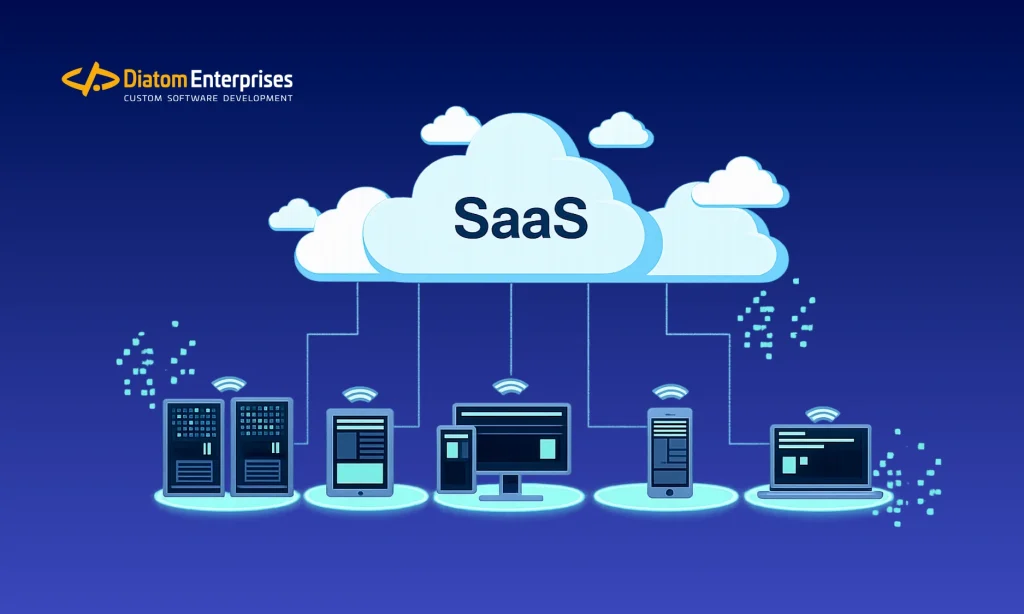
Software as a service is a method of delivering software applications over the internet, on a subscription basis, hosted and maintained by the vendor rather than installed and managed by the customer. Instead of purchasing a software license, installing the application on your own hardware, and taking responsibility for updates, security patches, and infrastructure management, customers of a SaaS product simply access it through a web browser or mobile app and pay a recurring fee – monthly or annually – for the right to use it.
The applications most business professionals use every day are SaaS products: Salesforce for customer relationship management, Slack for team communication, Zoom for video conferencing, HubSpot for marketing automation, Xero or QuickBooks Online for accounting. None of these require installation or local infrastructure management. They exist in the cloud, are accessible from any device with an internet connection, and are continuously maintained and improved by the companies that build them.
That combination – cloud delivery, subscription pricing, and vendor-managed infrastructure – is the essence of software as a service. Everything else that distinguishes the SaaS model flows from those three characteristics.
A Brief History: How SaaS Came to Dominate the Software Industry
To understand what software as a service represents, it helps to understand what it replaced. For most of the software industry’s history, software was sold as a product: a physical disc or a downloadable installer, accompanied by a license that permitted the purchaser to use the software on a defined number of machines. The customer was responsible for installation, for maintaining the hardware the software ran on, and for managing upgrades – which typically required purchasing new versions of the license every few years.
This model worked tolerably well when software was simpler and business computing was less interconnected. As software became more complex, more networked, and more central to how businesses operated, the limitations of the traditional model became increasingly costly. Upgrades were disruptive and expensive. Security vulnerabilities required emergency patching cycles that strained IT departments. Customization was difficult and fragile. And the capital expenditure model of software purchasing was poorly suited to businesses that needed to scale their technology use up or down as circumstances changed.
The emergence of reliable broadband internet in the late 1990s and early 2000s created the technical conditions for a different model. Salesforce, founded in 1999 with the explicit mission of delivering enterprise software over the internet without the need for installation or on-premise infrastructure, is widely credited as the pioneer that demonstrated SaaS was commercially viable at scale. What followed over the next two decades was a comprehensive shift in how software is built, distributed, and consumed – one that has fundamentally changed the economics of the software industry and the relationship between software vendors and their customers. An era of software service came into being.
What Is a SaaS Company, and How Does It Operate?
A SaaS company is a business that builds, hosts, and continuously maintains a software product delivered to customers over the internet on a subscription basis. Understanding what a SaaS company is requires understanding not just what it sells, but how it is structurally different from other types of software businesses – and from businesses in general.
The Subscription Revenue Model
The defining financial characteristic of a SaaS company is that its revenue is recurring. Rather than recognizing a large one-time payment when a customer purchases a license, a SaaS company recognizes revenue incrementally over the life of the subscription. This creates a more predictable revenue stream than traditional software sales, but it also means that a SaaS company must continuously earn its customers’ continued subscription – through product quality, ongoing development, and customer support – in a way that a company that has already collected a large upfront payment does not.
Multi-Tenancy and Shared Infrastructure
Most SaaS products are multi-tenant: a single instance of the software serves many customers simultaneously from shared cloud infrastructure. Each customer’s data is logically isolated – they cannot see or access each other’s information – but the underlying application and infrastructure are shared. This architecture is what makes SaaS economically efficient: the cost of running the software does not scale linearly with the number of customers, because additional customers are served by the same infrastructure rather than requiring dedicated instances of the application.
Continuous Development and Delivery
Because the vendor controls the infrastructure, SaaS companies can – and typically do – update their products continuously. Rather than releasing major version updates on an annual or biannual cycle, a SaaS company might deploy improvements to the product dozens of times per week. Customers always have access to the latest version without needing to manage an upgrade process. This continuous delivery model is one of the most significant operational differences between a SaaS company and a traditional software vendor, and it has profound implications for how SaaS companies are organized, how their engineering teams work, and what customers can expect from the products they use.
Customer Success as a Core Function
In a SaaS business, the commercial relationship with a customer does not conclude at the point of sale – it begins there. The subscription model means that revenue is earned over time, and retaining customers is as commercially important as acquiring new ones. This economic reality has given rise to the customer success function: a discipline dedicated to ensuring that customers derive genuine value from the product, adopt it fully, expand their use of it over time, and renew their subscriptions. Customer success is not a feature of SaaS products – it is a structural requirement of the SaaS business model.
How SaaS Differs from Traditional Software
The differences between software as a service and traditional on-premise software are significant enough to affect nearly every aspect of how software is purchased, managed, and experienced. The following comparison illustrates the most important distinctions.
Deployment and Access
Traditional software is installed on local hardware – servers managed by the customer’s IT department, or individual user machines. SaaS is accessed through a web browser or dedicated app, with no local installation required. For the customer, this eliminates the need to provision and manage infrastructure and makes the software accessible from any device with an internet connection.
Pricing and Cost Structure
Traditional software typically requires a significant upfront license purchase, often accompanied by annual maintenance fees for continued support and updates. SaaS is priced as a recurring subscription – monthly or annually – with costs that scale with usage or the number of users. This converts what was previously a capital expenditure into an operating expense, which many businesses find preferable for budgeting and cash flow management.
Updates and Maintenance
With traditional software, the customer is responsible for managing upgrades and patches, often working with an IT team to test and deploy new versions. With SaaS, the vendor manages all updates and maintenance. Customers benefit from new features and security patches automatically, without managing an upgrade cycle.
Customization
Traditional enterprise software was frequently customized heavily to match the specific processes of the purchasing organization – often at significant cost and with lasting implications for the ability to upgrade. SaaS products are configured rather than customized; they offer flexibility within defined parameters but rarely the degree of bespoke modification that on-premise software historically accommodated. This trade-off – less customization in exchange for lower complexity and faster access to innovation – is one that most organizations have found worthwhile.
Data Control
On-premise software keeps data within the organization’s own infrastructure, which some industries and organizations prefer for compliance or sovereignty reasons. SaaS stores data in the vendor’s cloud environment, which introduces different considerations around data security, privacy, and regulatory compliance – considerations that reputable SaaS vendors address through robust security certifications, data processing agreements, and transparent practices around data handling.
SaaS vs Traditional Software
| Area | SaaS | Traditional Software |
|---|---|---|
| Deployment | Accessed through the internet via browser or app | Installed on local machines or company servers |
| Pricing | Monthly or annual subscription | Large upfront license fee, often plus maintenance |
| Updates | Managed automatically by the vendor | Managed by the customer or internal IT team |
| Infrastructure | Hosted and maintained by the vendor | Owned or managed by the customer |
| Customization | Configured within defined product limits | Often heavily customized for specific needs |
| Scalability | Scales by adding users, usage, or plan tiers | May require additional hardware and IT work |
Quick takeaway: SaaS reduces infrastructure and maintenance responsibility for the customer, but usually offers less deep customization than traditional on-premise software.
The Core Advantages of Software as a Service
Software as a service has become the dominant model for business software delivery for a reason. The advantages it offers over traditional software are real and material – and they compound over time as both the products and the platforms they run on continue to improve.
Reduced time to value is perhaps the most immediately apparent advantage. A business evaluating a SaaS product can typically be up and running within hours or days, rather than the weeks or months that on-premise enterprise software implementations historically required. The absence of infrastructure procurement, installation, and configuration work translates directly into faster access to the functionality being purchased.
Lower total cost of ownership is a related but distinct advantage. The subscription model eliminates the capital expenditure of license purchases, the infrastructure costs of on-premise deployment, and the IT labor costs of ongoing maintenance. For small and medium-sized businesses that historically could not afford enterprise-grade software, SaaS has democratized access to capabilities that were previously available only to organizations with substantial IT budgets.
Continuous improvement means that SaaS customers benefit from an ever-improving product without managing an upgrade process. A product that a customer adopts today will be meaningfully more capable in twelve months – and the customer will have access to those improvements automatically, as part of the subscription they are already paying.
Scalability without infrastructure investment allows businesses to expand their use of SaaS products as they grow – adding users, increasing usage, or accessing more advanced tiers – without provisioning additional hardware or managing infrastructure capacity. This elastic scalability is particularly valuable for businesses with variable or unpredictable demand.
Accessibility and mobility are increasingly important in a business environment where distributed teams, remote work, and mobile access are the norm rather than the exception. SaaS products are accessible from any device with an internet connection, making them inherently suited to the way modern organizations work.
The Trade-Offs and Limitations of SaaS
An honest account of software as a service must also address its limitations. The SaaS model is not universally superior to alternatives, and businesses that adopt it without understanding its trade-offs can encounter challenges that were avoidable with more careful evaluation.
Ongoing cost is the most visible limitation. Subscription fees that appear modest on a per-user, per-month basis accumulate significantly over time. A business that has used a SaaS product for five years will have paid considerably more in total than the upfront cost of a traditional license would have been – though the comparison must account for the infrastructure, maintenance, and upgrade costs that the traditional model also carries.
Vendor dependency is a structural reality of the SaaS relationship. The customer’s continued access to their own business-critical software depends on the vendor’s continued operation, pricing decisions, and product direction. Vendor lock-in – the difficulty of migrating away from a SaaS product once organizational processes and data are embedded within it – is a genuine risk that deserves consideration, particularly for systems that will be deeply integrated into core business operations.
Limited customization, as noted above, is an inherent characteristic of the multi-tenant SaaS model. Organizations with highly specific process requirements that cannot be accommodated within a SaaS product’s configuration options may find that the product does not meet their needs – or that meeting them requires expensive workarounds that erode the cost advantages the SaaS model otherwise offers.
Internet dependency means that SaaS products are unavailable during connectivity outages. For most business environments, this is a manageable risk – but for organizations operating in environments with unreliable connectivity, or for use cases where offline access is essential, it is a genuine constraint.
Data privacy and compliance considerations vary by industry and geography. Organizations operating under strict data residency requirements, sector-specific regulations, or policies that restrict data from being held by third parties need to evaluate SaaS products carefully against those requirements before adoption.
SaaS Advantages and Trade-Offs
| Advantage | What It Means | Trade-Off to Consider |
|---|---|---|
| Faster time to value | Businesses can start using the product quickly without infrastructure setup | Enterprise-scale setup may still require configuration and integration work |
| Lower upfront cost | No large initial license or hardware investment is required | Subscription costs can accumulate significantly over time |
| Continuous improvement | New features and security updates are delivered automatically | Customers have less control over product changes and roadmap decisions |
| Scalability | Usage can grow without major infrastructure planning | Pricing may increase as users, data, or usage volumes grow |
| Accessibility | Teams can access the product from different locations and devices | Reliable internet access becomes essential |
| Vendor-managed operations | The vendor handles hosting, maintenance, and uptime | The business becomes dependent on the vendor’s stability and service quality |
Quick takeaway: SaaS usually simplifies adoption and operations, but businesses still need to evaluate long-term cost, vendor dependency, compliance, and integration requirements.
Types of SaaS: Horizontal, Vertical, and Everything In Between
Not all SaaS products are alike. Understanding the main categories of SaaS helps clarify how the model applies across different markets and customer types.
Horizontal SaaS
Horizontal SaaS products serve a broad range of industries by addressing business functions that exist in virtually every organization – communication, project management, HR, finance, marketing, and customer relationship management. Products like Slack, Asana, Workday, and HubSpot are horizontal SaaS: their value proposition does not depend on industry-specific knowledge and their addressable market is correspondingly large. The competitive dynamics in horizontal SaaS categories are intense, because the same large market that makes them attractive also draws significant competition.
Vertical SaaS
Vertical SaaS products are designed for a specific industry or sector, incorporating domain-specific functionality, compliance requirements, and workflows that horizontal products cannot accommodate without significant customization. Practice management software for healthcare providers, property management platforms for real estate businesses, and compliance tools for financial services firms are all examples of vertical SaaS. The addressable market for vertical SaaS is smaller, but the depth of product-market fit it can achieve – and the higher barriers to competitive displacement that domain specificity creates – often produce better unit economics than horizontal markets allow.
B2B and B2C SaaS
SaaS products are also distinguished by their customer type. Business-to-business SaaS sells to organizations, typically through sales teams or self-serve channels, with pricing that reflects the commercial value delivered to the business. Business-to-consumer SaaS sells to individuals – productivity tools, creative software, personal finance applications – often at lower price points with higher volume and different retention dynamics. The product development, marketing, and customer success requirements of B2B and B2C SaaS differ substantially, and the distinction matters for anyone evaluating a SaaS business or considering how to build one.
Key SaaS Metrics Every Business Leader Should Understand
The SaaS business model has its own vocabulary of performance metrics that reflect the economics of recurring revenue. Whether you are evaluating a SaaS vendor, investing in a SaaS company, or building one, familiarity with these metrics is essential.
Monthly Recurring Revenue (MRR) and Annual Recurring Revenue (ARR)
MRR is the predictable, recurring revenue a SaaS business generates each month from active subscriptions. ARR is the annualized equivalent. These are the primary top-line metrics for a SaaS business – more meaningful than total revenue because they reflect the recurring, predictable portion of the business rather than one-time items.
Churn Rate
Churn is the rate at which customers cancel their subscriptions. Customer churn measures the percentage of customers lost in a period; revenue churn measures the percentage of recurring revenue lost. High churn is the most common cause of SaaS business failure: a product that acquires customers but cannot retain them is filling a leaking bucket, and the cost of acquisition compounds without producing lasting revenue.
Customer Lifetime Value (LTV)
LTV is the total revenue a SaaS business can expect to generate from a customer over the life of the relationship. It is a function of average revenue per customer and the average duration of the customer relationship. LTV is meaningful in relation to the cost of acquiring that customer – the LTV to CAC ratio is one of the most widely used indicators of SaaS business health.
Customer Acquisition Cost (CAC)
CAC is the total cost of acquiring a new customer, including sales and marketing expenses. A sustainable SaaS business acquires customers at a cost that is substantially lower than the lifetime value those customers generate – the conventional benchmark is an LTV at least three times the CAC, with the CAC recovered within twelve months.
Net Revenue Retention (NRR)
NRR measures whether the revenue from an existing cohort of customers is growing or shrinking over time, accounting for expansion revenue from upgrades and additional seats as well as losses from churn and downgrades. NRR above 100% – meaning existing customers are spending more over time than they were at the start of the period – is the defining characteristic of a highly efficient SaaS business and a powerful indicator of product-market fit.
Key SaaS Metrics Explained
| Metric | What It Measures | Why It Matters |
|---|---|---|
| MRR | Monthly recurring revenue from active subscriptions | Shows the predictable monthly revenue base of the business |
| ARR | Annualized recurring revenue | Helps evaluate the business at an annual revenue level |
| Churn Rate | The rate at which customers or revenue are lost | High churn signals retention problems and weakens growth |
| LTV | Expected revenue from a customer over the full relationship | Shows how valuable each customer is over time |
| CAC | The cost of acquiring a new customer | Helps determine whether growth is financially sustainable |
| NRR | Revenue retained and expanded from existing customers | Indicates whether customers are growing their usage over time |
Quick takeaway: A healthy SaaS business does not only acquire customers efficiently — it retains them, expands revenue from them, and keeps churn under control.
What SaaS Means for Businesses Buying Software
For organizations evaluating software investments, the prevalence of SaaS has changed the nature of the purchasing decision in several important ways.
The lower barrier to adoption that SaaS offers has made it easier to try before committing. Most SaaS vendors offer free trials or freemium tiers that allow prospective customers to evaluate the product with real use cases before signing a contract. This reduces the risk of poor purchasing decisions but also increases the importance of evaluating products rigorously during the trial period – because the ease of adoption can create a false sense of confidence that does not survive contact with edge cases and enterprise-scale usage.
Vendor evaluation should extend beyond the product itself to the vendor’s financial health, customer support quality, data security practices, and roadmap transparency. A SaaS product that is discontinued, acquired, or allowed to stagnate by a vendor in financial difficulty creates business continuity risk for every customer relying on it. The viability of the vendor is as important as the capability of the product.
Integration capability has become a critical dimension of SaaS evaluation. Modern business technology stacks typically include dozens of SaaS products that need to share data and workflows with each other. A SaaS product that integrates well with the rest of the organization’s technology environment delivers significantly more value than one that operates in isolation – and the friction of poor integration is one of the most consistent sources of dissatisfaction in SaaS adoption.
Contract terms deserve careful attention, particularly around data portability – the ability to export data in a usable format if the relationship ends – and around pricing escalation, which is a common source of tension at renewal time as vendors seek to increase revenue from established customer relationships.
What SaaS Means for Businesses Building Software
For businesses considering whether to build and deliver software as a service – whether as a standalone product or as a complement to existing services – the SaaS model offers compelling advantages alongside demands that are easy to underestimate.
The recurring revenue model, once established, creates compounding business value. Each customer retained is revenue that does not need to be re-won. Expansion revenue from existing customers – additional users, higher-tier plans, add-on products – can drive growth without proportional increases in sales and marketing cost. The most successful SaaS businesses grow not just by acquiring new customers but by deepening their relationship with existing ones.
But the path to that compounding value is more demanding than it might appear. Building a SaaS product requires engineering investment in multi-tenancy, security, scalability, and continuous delivery infrastructure that goes well beyond building software for a single customer. Operating a SaaS product requires ongoing investment in reliability, customer support, and continuous development that does not end at launch. And competing in SaaS markets – where the barriers to entry are lower than in traditional software but the pace of product iteration is faster – requires sustained execution across product, engineering, sales, marketing, and customer success simultaneously.
Organizations that approach SaaS with clear-eyed understanding of these demands – and the right technical partners to help them meet them – are far better positioned to build products that grow into durable, valuable businesses than those that see the subscription model as simply a pricing change applied to software they were already planning to build.
Is SaaS Right for Your Situation?
Software as a service is not a universal answer to every software need – but it has become the default answer for most, and for good reason. The combination of lower upfront cost, faster time to value, continuous improvement, and elastic scalability makes it the right choice for the majority of business software use cases. The limitations – ongoing cost, vendor dependency, reduced customization, and internet dependency – are real, but for most organizations they are manageable trade-offs rather than disqualifying constraints.
For businesses buying software, the question is not whether to consider SaaS – it is how to evaluate SaaS products rigorously, negotiate contracts thoughtfully, and manage the vendor relationships that SaaS creates. For businesses building software, the question is how to develop a SaaS product with the architectural discipline, operational capability, and customer orientation that the model demands.
Understanding what software as a service is – genuinely, not just superficially – is the foundation for both of those decisions.
At Diatom Enterprises, we work with founders, product leaders, and established businesses to design and build SaaS products that are technically sound, commercially purposeful, and built to last. Whether you are exploring whether a SaaS model is right for your software idea or are ready to begin building, our team brings the experience to guide the decisions that matter most.
Get in touch for a free consultation, and let’s explore what the right approach looks like for your situation.