
AI vs Automation: Deterministic and Non-Deterministic Systems Explained

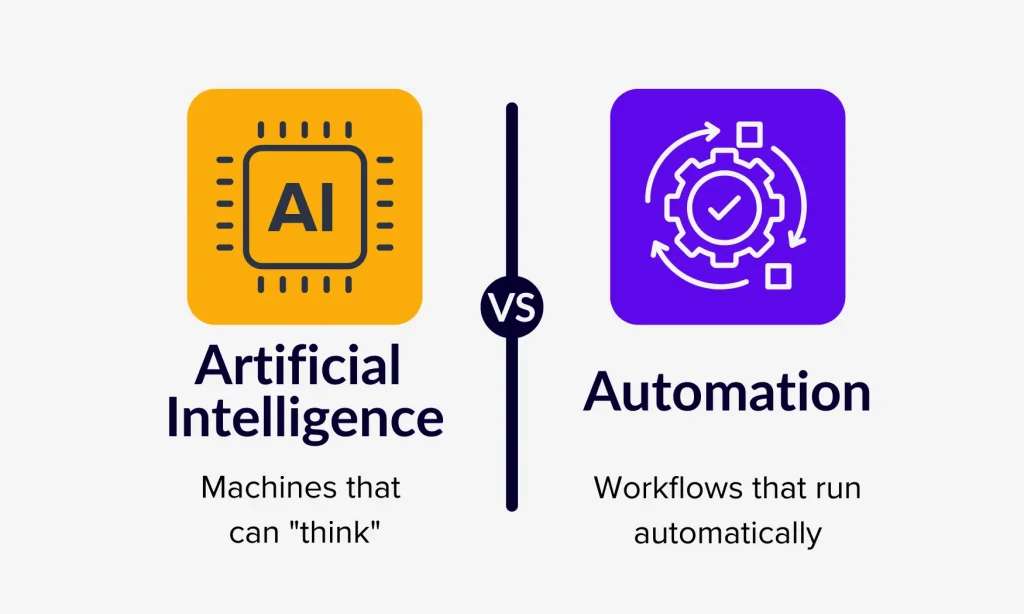
“AI” and “automation” get used interchangeably in boardrooms, but they solve different classes of problems with different economics and different failure modes. This guide breaks down deterministic versus non-deterministic systems and shows technical leaders how to deploy each for maximum operational and economic return.
AI vs. Automation: Two Different Engines Under One Umbrella
“AI” and “automation” have become interchangeable in enterprise vocabulary, and that collapse in language is costing organizations real budget. The two are not competing labels for the same capability; they are distinct engineering approaches, each suited to a different category of problem. Conflating them leads technical leaders to apply the wrong tool to a workflow, either over-engineering a task that a five-line script could handle or under-engineering a task that requires genuine inference over unstructured input.
Automation, in its classical sense, is the execution of a fixed decision path. A workflow engine or RPA bot follows an explicit, human-authored sequence of conditional logic: if the invoice total matches the purchase order, route to approval; if inventory drops below a threshold, trigger a reorder. Every branch is known in advance, because a person wrote it.
AI, particularly the generative and machine-learning systems now embedded across enterprise software, does not follow an authored path. It infers an output from patterns learned across training data, producing a result that was never explicitly programmed for that exact input. Understanding which of these two computational models a given business problem actually calls for is the first strategic decision in any modern software initiative, and it is the question this guide is built to answer.
This confusion is not merely semantic. Procurement teams routinely evaluate a rules-based workflow tool and a large language model against the same RFP criteria, as though the two were substitutable. They are not. A workflow engine cannot read a free-text customer complaint and infer sentiment; a generative model cannot guarantee that a payroll figure will be bit-for-bit identical on every run.
Selecting the wrong category of system for a given task does not just waste budget, it introduces the exact failure mode the business was trying to eliminate, whether that is unpredictable output inside a compliance process or brittle, over-engineered logic in a task that genuinely required inference.
The distinction also shapes how each system is bought, staffed, and governed. Automation platforms are typically licensed, configured, and maintained by a business-process or IT operations team, with success measured in cycle-time reduction and error-rate elimination.
AI systems increasingly require data science and machine-learning engineering discipline, ongoing model evaluation, and tolerance for iterative improvement rather than one-time configuration. Treating both under a single “digital transformation” budget line, governed by a single team, is one of the more common strategic missteps enterprises make when scaling either capability.
Deterministic vs. Non-Deterministic AI: The Core Technical Distinction
The deterministic-versus-non-deterministic split is the technical backbone beneath the AI-versus-automation conversation, and it applies inside AI itself, not just between AI and automation.
A deterministic system produces the same output every time it receives the same input. Traditional rules engines, workflow automation, and classical if-then logic all fall into this category by design; a tax calculation module must return an identical figure on every run, or it is defective. Determinism is what makes a system auditable: an engineer can trace precisely why a given output occurred, replay the exact conditions, and certify the result for regulators or auditors.
A non-deterministic system can produce different outputs from an identical input, because its logic is probabilistic rather than fixed. Generative AI models, including large language models and diffusion-based image systems, sample from a learned probability distribution over possible outputs at inference time. Ask the same model the same question twice, and the wording, structure, or even the substance of the answer can shift, governed by sampling parameters like temperature and top-p.
It helps to think of this as a spectrum rather than a hard binary. Rules engines sit at the fully deterministic end. Classical, narrow machine-learning classifiers (fraud-scoring models, demand forecasts) sit closer to deterministic, since a fixed model with fixed weights will return a consistent score for a consistent input, even though the model itself was trained probabilistically. Generative transformers sit at the non-deterministic end, where variability is not a bug but an inherent property of how the system reasons.
It is worth noting that non-determinism can be dialed down, though rarely to zero. Setting a generative model’s sampling temperature close to zero makes its outputs far more repeatable, and some enterprise deployments deliberately constrain models this way for tasks like structured data extraction.
But this only narrows the variance; it does not restore the guarantee of a rules engine, because the underlying mechanism is still a probability distribution rather than an explicit branch of logic. An engineer can make a generative system more consistent, but cannot make it provably deterministic without changing its fundamental architecture.
This is also why the two failure modes look completely different in production. A deterministic system fails loudly: a missing condition throws an exception, a null value breaks a calculation, and the fault is immediately visible and traceable to a specific line of logic. A non-deterministic system fails quietly: the model returns a confident, well-formatted, entirely plausible answer that happens to be wrong, and nothing in the system’s behavior flags the error. Engineering teams that have only ever operated deterministic infrastructure often underestimate how much observability and evaluation tooling a probabilistic system demands simply to know when it has failed.
Where Deterministic Systems Win: Precision, Compliance, and Repeatable Logic
Deterministic automation remains the correct engineering choice for any process where the acceptable answer space is narrow, the rules are fully known, and the cost of an inconsistent output is high.
- Financial and regulatory calculations: payroll runs, tax computation, invoice-to-purchase-order matching, and general ledger postings must return the identical figure every time or the business fails an audit.
- Access control and safety interlocks: a permissions system or a manufacturing safety trip must behave predictably under every condition, with zero tolerance for probabilistic drift.
- High-volume, low-ambiguity transactions: reorder triggers, shipping label generation, and status-update routing are template-shaped tasks where a rules engine outperforms any model on cost and speed.
The economic case for deterministic automation is straightforward and well documented: it drives the marginal cost of a repeatable transaction toward zero. A rules engine does not require GPU inference cycles, does not hallucinate an incorrect field, and scales linearly with infrastructure that is orders of magnitude cheaper than a large model.
For any workflow that can be fully specified in advance, deterministic automation delivers the highest return per engineering dollar, because the cost of building it once is amortized indefinitely across every future transaction it will ever process.
This category of system also benefits from decades of mature tooling. Version control, unit testing, and formal verification all work cleanly against deterministic logic, because a test asserting a specific input produces a specific output is either true or false, with no probabilistic gray zone to account for.
That maturity translates directly into lower long-term maintenance cost: a business rule change is a code change, reviewable in a pull request and provably correct before it ever reaches production, rather than a retraining cycle whose effects on downstream behavior must be re-evaluated empirically.
Where Non-Deterministic AI Wins: Ambiguity, Judgment, and Unstructured Data
Non-deterministic, generative AI earns its cost when the problem cannot be reduced to a finite rule set, because the input space is effectively unbounded: free-text customer emails, scanned contracts, support call transcripts, product images, or open-ended natural-language questions.
- Unstructured data interpretation: summarizing a call transcript, extracting intent from a support ticket, or classifying a contract clause has no fixed enumeration of valid inputs; a rules engine would need an impossible number of branches to cover every phrasing.
- Judgment-adjacent tasks: drafting a first-pass response, triaging ambiguous cases, or generating a synthesis across disparate documents benefits from a model that generalizes past its training examples rather than matching a literal pattern.
- Forecasting under genuine uncertainty: demand or risk scenarios with incomplete information benefit from probabilistic reasoning that can express a distribution of outcomes rather than a single hard-coded threshold.
The economic contribution here is different in kind from automation’s cost reduction: generative AI unlocks value sitting inside data that was previously invisible to software, because no rules engine could ever be written broadly enough to parse it.
That said, non-determinism carries real engineering cost. Variable output demands evaluation harnesses, human-in-the-loop review for high-stakes decisions, and guardrails that catch hallucinated or out-of-policy responses before they reach a customer or a ledger.
There is also a labor-economics dimension worth naming directly. Deterministic automation historically displaced repetitive, rules-bound tasks-data entry, transaction routing, basic reconciliation. Non-deterministic AI is increasingly displacing or augmenting a different layer of work: first-draft writing, initial triage, preliminary research synthesis, and pattern detection across large unstructured corpora that would take a human analyst days to review manually.
For enterprises, the return on that second category shows up less as headcount reduction and more as compressed cycle time on judgment-heavy work, freeing skilled staff to spend their time on the exceptions and decisions that genuinely require human accountability.
Building the Hybrid Stack: Engineering Deterministic and Generative Logic Together
In production systems, the AI-versus-automation question rarely resolves to a single winner. The highest-performing enterprise architectures pair the two: a generative layer handles interpretation and reasoning over ambiguous input, while a deterministic layer enforces the business rules, validation, and audit trail before anything executes.
A practical pattern looks like this: a model reads an incoming vendor invoice and proposes a structured extraction of line items, vendor, and total. That proposal is not trusted blindly. A deterministic validation layer checks the extracted total against the purchase order, confirms the vendor exists in the approved registry, and only then commits the transaction to the general ledger. The generative component contributes flexibility and interpretation; the deterministic component contributes the guarantee that finance actually requires.
This orchestration pattern also determines where monitoring effort should be spent. The deterministic layer needs traditional application observability: uptime, latency, error logging. The generative layer needs a second, parallel discipline: continuous evaluation against labeled test sets, drift detection as real-world inputs diverge from training data, and clear escalation paths for low-confidence outputs.
Enterprises that only build the first kind of observability inherit systems where the automation half is fully instrumented and the AI half is a black box-precisely the configuration most likely to produce an undetected, costly error.
At Diatom Enterprises, we design these hybrid architectures for organizations that need both sides done correctly: rules engines and workflow automation that are fast, auditable, and cheap to run at scale, alongside generative AI components wrapped in the validation, monitoring, and guardrail infrastructure that keeps probabilistic output safe inside a business-critical system.
Get in touch through our signup form for a free architectural consultation, and let’s map out where deterministic automation and generative AI should each carry weight in your operations.