
AI vs Automation: Deterministic and Non-Deterministic Systems Explained

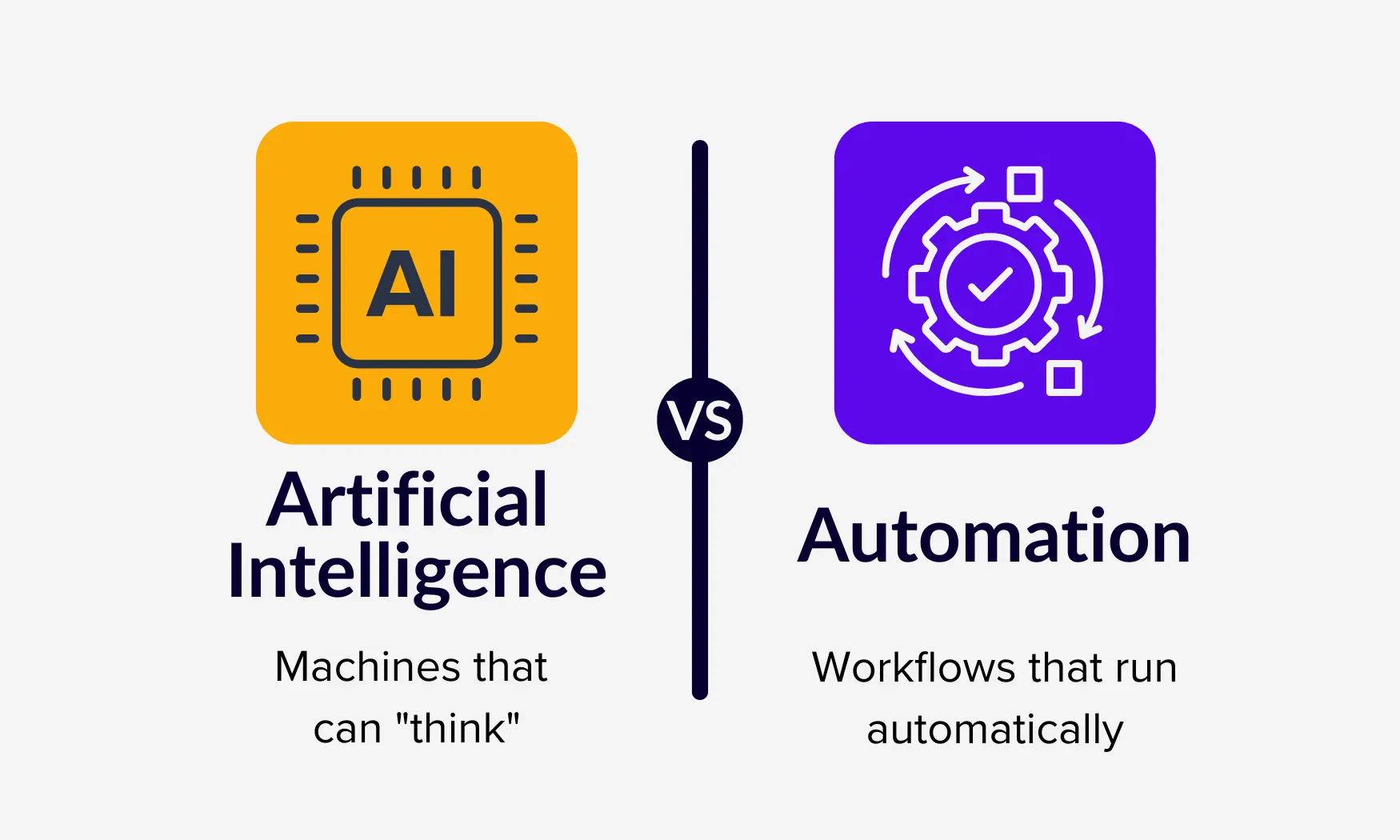
Table of content
AI vs automation is usually treated as a vocabulary question in boardrooms, but the two solve different classes of problems, with different economics and different failure modes. This guide explains deterministic vs non deterministic AI in concrete terms and shows technical leaders where each one belongs in a production system and how to combine them for the best operational and economic return.
AI vs. Automation: Two Different Engines Under One Umbrella
“AI” and “automation” have become interchangeable in enterprise vocabulary, and that loose language costs organizations real budget. They are distinct engineering approaches, each suited to a different category of problem. Mix them up and you either over-engineer a task that a five-line script could handle, or under-engineer a task that needs genuine inference over unstructured input.
Automation, in its classical sense, executes a fixed decision path. A workflow engine or robotic process automation bot follows an explicit, human-authored sequence of conditional logic: if the invoice total matches the purchase order, route it to approval; if inventory drops below a threshold, trigger a reorder. Every branch is known in advance. In practice this means BPMN workflow engines such as Camunda, RPA platforms such as UiPath or Microsoft Power Automate, and plenty of plain scheduled scripts.
AI, particularly the generative and machine-learning systems now embedded across enterprise software, does not follow an authored path. It infers an output from patterns learned across training data, producing a result that was never explicitly programmed for that exact input. Deciding which of the two a business problem calls for is the first strategic decision in any modern software initiative.
Procurement teams still evaluate a rules-based workflow tool and a large language model against the same RFP criteria, as though the two were substitutable. A workflow engine cannot read a free-text customer complaint and infer sentiment; a generative model cannot guarantee that a payroll figure will be bit-for-bit identical on every run.
Picking the wrong category brings in the failure mode the business wanted to remove: unpredictable output inside a compliance process, or brittle logic in a task that needed inference.
The two are also staffed and governed differently. An automation platform is configured once by a business-process or IT operations team and judged on cycle time and error rates. An AI system needs machine-learning engineers and ongoing evaluation, so putting both under one “digital transformation” budget line, owned by one team, is a common mistake when enterprises scale either.
Deterministic vs. Non-Deterministic AI: The Core Technical Distinction
The deterministic-versus-non-deterministic split sits beneath the AI-versus-automation conversation, and it applies inside AI itself too.
A deterministic system produces the same output every time it receives the same input. Traditional rules engines, workflow automation, and classical if-then logic all fall into this category by design; a tax calculation module must return an identical figure on every run, or it is defective. A deterministic decision engine, for example a DMN decision table evaluated by Camunda or a Drools rule set, returns the same decision for the same facts and can log exactly which rule fired. Determinism is what makes a system auditable: an engineer can trace why a given output occurred, replay the exact conditions, and certify the result for regulators or auditors.
A non-deterministic system can produce different outputs from an identical input, because its logic is probabilistic rather than fixed. Generative AI models, including large language models and diffusion-based image systems, sample from a learned probability distribution over possible outputs at inference time. Ask the same model the same question twice, and the wording or even the substance of the answer can shift, governed by sampling parameters like temperature and top-p.
It helps to think of this as a spectrum rather than a hard binary. Rules engines sit at the fully deterministic end. Classical, narrow machine-learning classifiers (fraud-scoring models, demand forecasts) sit close to it, since a fixed model with fixed weights will return a consistent score for a consistent input, even though the model itself was trained probabilistically. Generative transformers sit at the non-deterministic end, where variability is an inherent property of how the system produces text, not a bug.
Non-determinism can be dialed down, though in a hosted model rarely to zero. Teams set temperature to 0 for tasks like data extraction, and identical requests still came back different. In a September 2025 experiment, Thinking Machines Lab sampled 1,000 completions of one prompt at temperature 0 and got 80 distinct outputs, because the server batches each request with other traffic and the arithmetic shifts with batch size (their analysis). The knob itself is going away: Anthropic’s newer Claude models accept only the default sampling settings, and its API version dated 21 October 2026 rejects the temperature parameter outright (migration guide). Several reasoning models from other vendors restrict it as well.
What you can control is the shape of the output. Structured output modes in the OpenAI and Claude APIs constrain a response to a JSON schema, so the fields and their types are guaranteed. The values inside those fields are not. An engineer can make a generative system more consistent, but cannot make it provably deterministic without changing its architecture.
The two failure modes also look different in production. A deterministic system fails loudly: a missing condition throws an exception, and the fault traces to a specific line of logic. A non-deterministic system fails quietly: the model returns a confident, well-formatted, plausible answer that happens to be wrong, and nothing flags the error. Teams that have only run deterministic infrastructure often underestimate how much evaluation tooling a probabilistic system needs simply to know when it has failed.
Where Deterministic Systems Win: Precision, Compliance, and Repeatable Logic
Deterministic automation remains the correct engineering choice for any process where the acceptable answer space is narrow, the rules are fully known, and the cost of an inconsistent output is high.
- Financial and regulatory calculations: payroll runs, tax computation, invoice-to-purchase-order matching, and general ledger postings must return the identical figure every time or the business fails an audit.
- Access control and safety interlocks: a permissions system or a machine safety trip must behave predictably under every condition, with zero tolerance for probabilistic drift. On the factory floor this is deterministic control automation: a PLC runs IEC 61131-3 logic in a fixed scan cycle, and safety functions are engineered to standards such as IEC 61508 rather than learned from data.
- High-volume, low-ambiguity transactions: reorder triggers, shipping label generation, and status-update routing are template-shaped tasks where a rules engine beats any model on cost and speed.
The economic case for deterministic automation is simple: it drives the marginal cost of a repeatable transaction toward zero. A rules engine needs no GPU inference, never hallucinates a field, and runs on infrastructure that costs a fraction of what a large model needs. For any workflow that can be fully specified in advance, it gives the highest return per engineering dollar, because the cost of building it once is spread across every future transaction.
Deterministic logic also benefits from decades of mature tooling. A unit test asserting that a specific input produces a specific output is either true or false, so a business rule change is a code change, reviewed in a pull request and tested before release, rather than a retraining cycle whose downstream effects must be re-evaluated empirically.
Where Non-Deterministic AI Wins: Ambiguity, Judgment, and Unstructured Data
Generative AI earns its cost when the problem cannot be reduced to a finite rule set because the input space is effectively unbounded: free-text customer emails, scanned contracts, support call transcripts, product images, or open-ended natural-language questions.
- Unstructured data interpretation: summarizing a call transcript, extracting intent from a support ticket, or classifying a contract clause has no fixed enumeration of valid inputs; a rules engine would need an impossible number of branches to cover every phrasing.
- Judgment-adjacent tasks: drafting a first-pass response or triaging ambiguous cases benefits from a model that generalizes past its training examples instead of matching a literal pattern.
- Forecasting under genuine uncertainty: demand or risk scenarios with incomplete information benefit from probabilistic reasoning that can express a distribution of outcomes rather than a single hard-coded threshold.
The economic contribution here differs in kind from automation’s cost reduction: generative AI gets value out of data that was previously invisible to software, because no rules engine could ever be written broadly enough to parse it.
Non-determinism carries real engineering cost, though. Variable output demands evaluation harnesses, human-in-the-loop review for high-stakes decisions, and guardrails that catch hallucinated or out-of-policy responses before they reach a customer or a ledger.
The labor effect differs too. Deterministic automation took over rules-bound tasks such as data entry and basic reconciliation. Non-deterministic AI assists a different layer of work: first drafts, initial triage, research synthesis, and pattern detection across documents that would take an analyst days to read. The return shows up less as headcount reduction and more as shorter cycle times on judgment-heavy work, which frees skilled staff for decisions that require human accountability.
Building the Hybrid Stack: Engineering Deterministic and Generative Logic Together
In production systems, the AI-versus-automation question rarely resolves to a single winner. The strongest enterprise architectures pair the two: a generative layer handles interpretation and reasoning over ambiguous input, while a deterministic layer enforces the business rules and keeps the audit trail before anything executes. This pairing is what the market now sells as intelligent automation.
A practical pattern looks like this: a model reads an incoming vendor invoice and proposes a structured extraction of line items, vendor and total, returned against a fixed JSON schema. That proposal is not trusted blindly. A deterministic validation layer checks the extracted total against the purchase order, confirms the vendor exists in the approved registry, and only then commits the transaction to the general ledger. Anything that fails a check goes to a person, with the model’s proposal attached. The model contributes interpretation; the deterministic layer contributes the guarantee finance requires.
This pattern also determines where monitoring effort should go. The deterministic layer needs traditional application observability: uptime, latency, error logging. The generative layer needs continuous evaluation against labeled test sets, drift detection as real inputs diverge from training data, and escalation paths for low-confidence outputs. Build only the first kind and the AI half stays a black box, which is how undetected, costly errors happen.
At Diatom Enterprises, we have built AI systems since 2019 and design these hybrid architectures for organizations that need both sides done correctly: rules engines and workflow automation that are fast and cheap to run at scale, alongside generative AI components wrapped in validation and monitoring, with every AI output reviewed by a senior engineer before it ships.
Get in touch through our signup form for a free architectural consultation, and let’s map out where deterministic automation and generative AI should each carry weight in your operations.
AI vs Automation: Frequently Asked Questions
- What does deterministic vs non deterministic AI mean in practice? Run the same input through the system 100 times and count the distinct outputs. A rules engine, or a classifier with frozen weights on a pinned runtime, gives you one. A hosted large language model usually gives you several, even with sampling turned down as far as the API allows.
- What’s the difference between deterministic and ai-based checks in hardware design? Deterministic checks such as design rule checking, layout versus schematic (LVS), static timing analysis and formal equivalence checking return the same verdict for the same design every time, and chip sign-off rests on them. AI-based tools such as Synopsys VSO.ai use machine learning to rank regression tests and close coverage gaps faster. They decide where engineers look first; sign-off stays deterministic.
- Can AI in a factory deliver the exact same output from the same data every time? Yes, for narrow models, if you freeze the model version, pin the runtime and hardware, and turn on the framework’s deterministic mode (PyTorch has
torch.use_deterministic_algorithms). Replay a fixed test set after every update. Keep safety functions in deterministic control automation, and do not put a generative model in the control loop. - What is a deterministic decision engine? It is software that evaluates explicit rules or decision tables, such as DMN tables or Drools rules, and returns the same decision for the same facts with a record of the rule that fired. In a hybrid system, a model’s output is one of those facts.


