Editor’s note: written in mid-2023, before .NET 8 shipped as an LTS release in November 2023.
The field of software development is continuously shifting. As technology propels forward, development platforms like .NET adapt, evolving to accommodate the changing needs and demands of both developers and end-users. Renowned for its speed, cross-platform support, and thriving community, .NET remains a go-to choice for developers worldwide. This article looks at what software development with .NET 8 was expected to bring.
The Current State of .NET
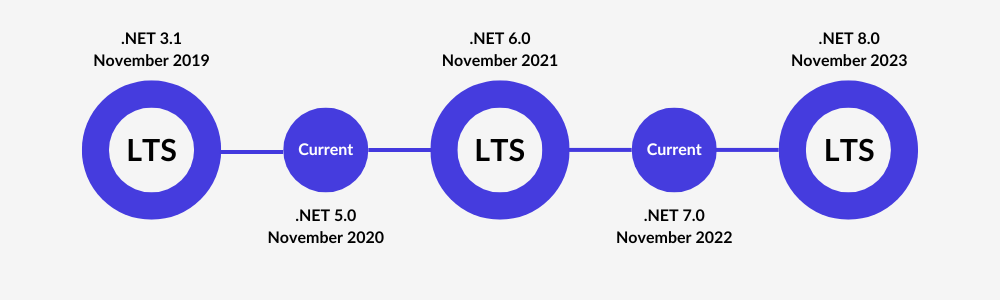
In mid-2023, up-to-date versions of .NET included .NET 6 for Long-Term Support (LTS) and .NET 7 for Standard-Term Support (STS). While .NET 7 introduced an array of new features, many companies have opted to stick with LTS releases due to their sustained support. Consequently, the next LTS release, .NET 8, anticipated in November 2023, is set to be a major milestone for developers and businesses alike.
.NET 8: Enhancements and Opportunities
Boasting all the features of .NET 7, alongside additional innovations, .NET 8 will provide developers with a wealth of new opportunities and improvements, which are detailed comprehensively on Microsoft’s official website here.
Harnessing the Power of Native AOT in .NET 8
One notable .NET 7 feature expected to be extended in .NET 8 is the native Ahead-Of-Time (AOT) deployment mode. The capability to publish an application as native AOT yields a self-contained application that has been pre-compiled to native code. Consequently, native AOT applications start up remarkably quickly, utilize less memory, and the published executable is smaller than in the normal self-contained mode.
Native AOT proves particularly beneficial for cloud infrastructure and hyper-scale services due to the substantial impact on workloads with high deployment instances. Thus, the extension of native AOT in .NET 8 presents a significant advancement eagerly anticipated by many companies.
Comparative Analysis of Application Startup Time Across Different Deployments
To illustrate the strides in deployment time with .NET 8, let’s examine a comparison using the startup time of a simple “Hello World!” application. The measurements, conducted on a high-performance PC with a PowerShell script, run the application 50 times, taking an average time value for starting and completing the process.
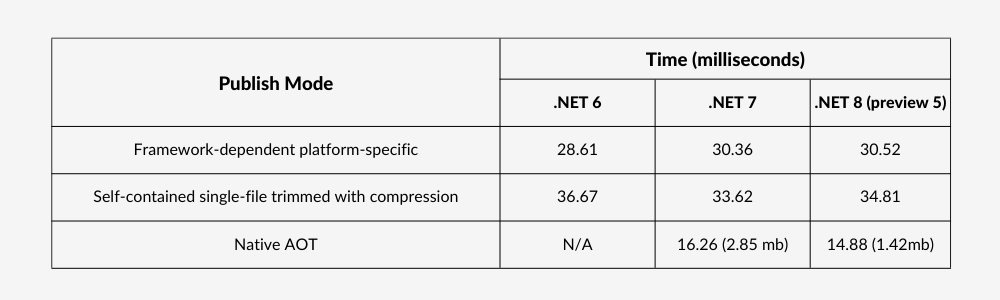
Here’s what we can derive from the data:
- Framework-dependent platform-specific deployment times showed minimal differences between .NET 7 and .NET 8, though both were marginally slower than .NET 6, potentially due to referencing additional logic in the framework.
- Self-contained single-file trimmed with compression deployment times demonstrated slight improvements when using .NET 7/8.
- Native AOT deployment showed marked improvements in .NET 8 for both time and size measures. It’s considerably faster and smaller than any other deployment supported by .NET 6.
In addition to the above, .NET 8 will offer fresh updates for ASP.NET Core, .NET Blazor, and .NET MAUI platforms. This bodes well for .NET developers and businesses seeking to optimize the performance and size of their products.
Embracing .NET 8 Preview with Visual Studio 2022
Developers eager to experiment with the .NET 8 preview in Visual Studio 2022 can follow these steps:
- Install the latest version of the .NET 8 preview SDK.
- Install the latest preview of Visual Studio 2022 (17.7) or use the latest version (17.6) with enabled preview features (Go to: Tools / Manage Preview Features / Environment / Preview Features / Use preview of the .NET SDK).
Update (October 2026): The .NET 8 LTS release date was 14 November 2023, when Microsoft announced general availability with Visual Studio 2022 17.8, so the preview steps above are no longer needed; our .NET 8 Blazor updates article covers the Blazor changes. Support for .NET 8 ended on 10 November 2026; new projects and upgrades should target .NET 10, the current LTS release, or .NET 11 (what’s new in .NET 11), both of which Microsoft supports until 14 November 2028.
Put .NET 8 and .NET 10 to Work with Diatom Enterprises
The release of .NET 8 is poised to make a significant impact in the software development world. It is a major leap forward, offering substantial improvements in performance, flexibility, and developer experience. As we at Diatom Enterprises, a custom software development company, closely follow these developments, we’re excited to use the capabilities of .NET 8 to deliver cutting-edge solutions for our clients.
Explore how Diatom Enterprises can help you build new software on .NET 10 or move your .NET 8 applications to a supported version.